English
 Chinese
Scan QRCode

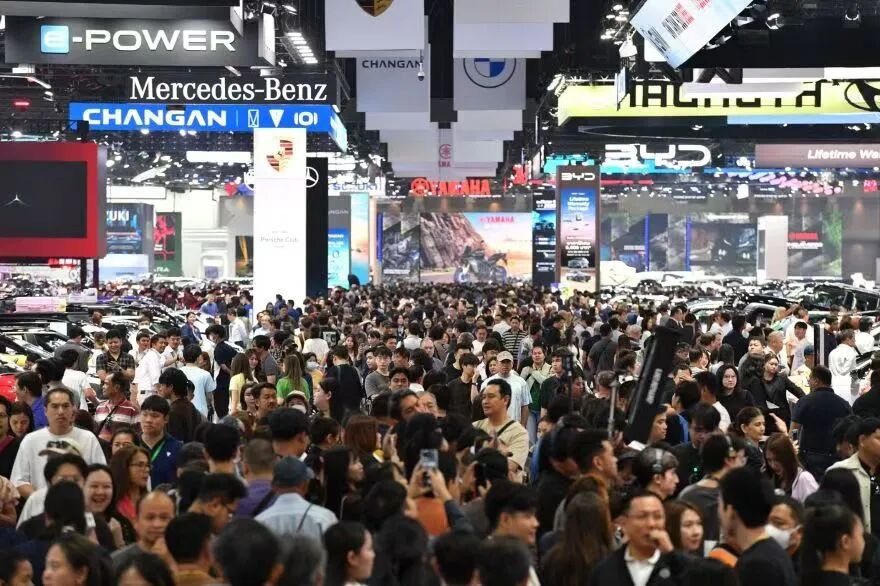
Thailand is a significant automobile manufacturing hub and export base in Southeast Asia. Leveraging its highly mature industrial ecosystem and comprehensive parts supply capabilities, Thailand has consistently ranked first in the region in terms of automobile production, earning it the title of "Detroit of the East". The Bangkok International Motor Show, the largest and most influential auto show in Southeast Asia, stands out for its commercial value and is widely recognized as a trendsetter in the Southeast Asian automotive market. Over the past few years, the Bangkok International Motor Show has maintained a distinctive industry tradition: on the closing day of the show, the organizers release a comprehensive report on the on-site reservations made by each participating brand, presenting the latest market landscape through real sales data.
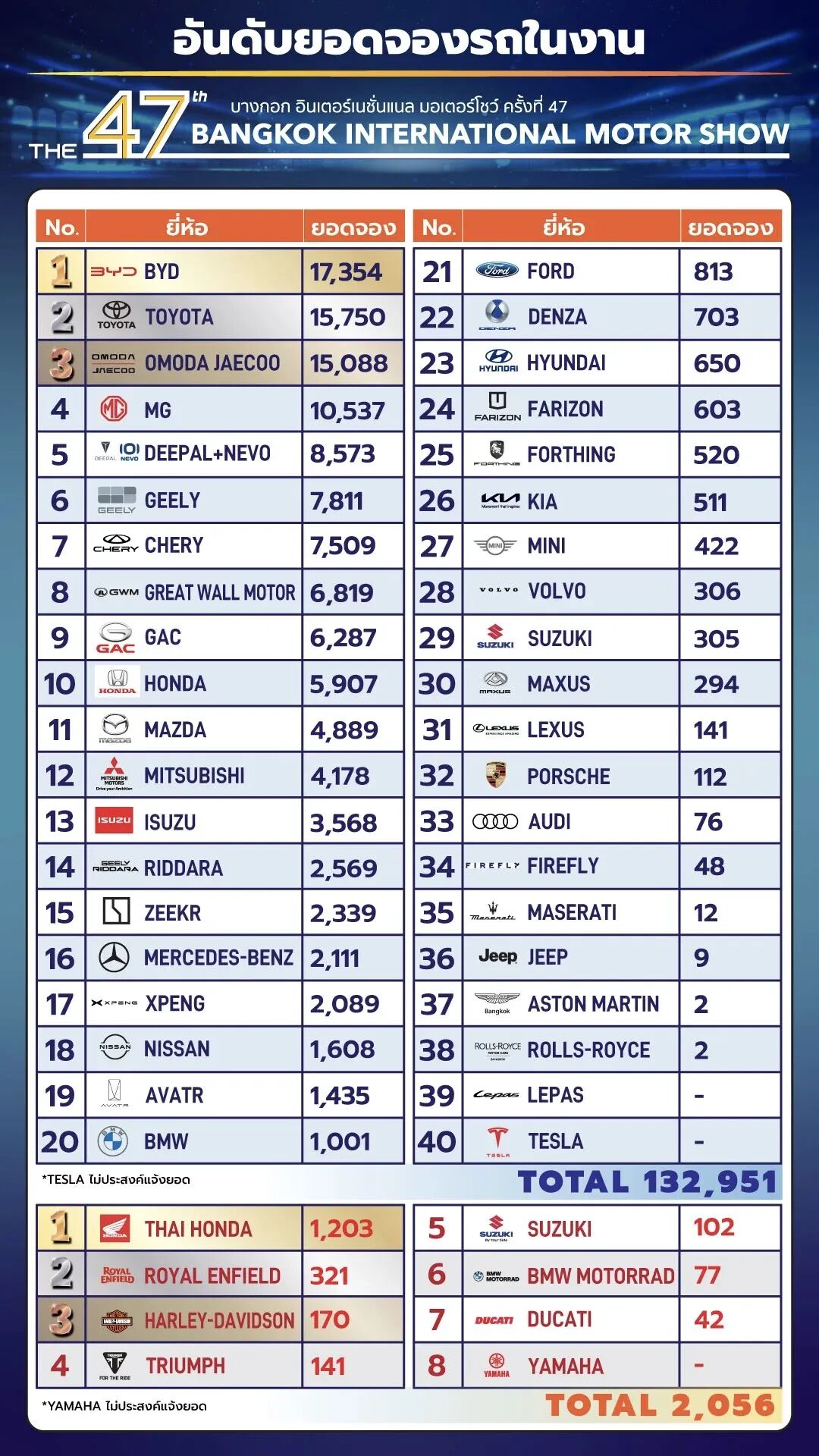
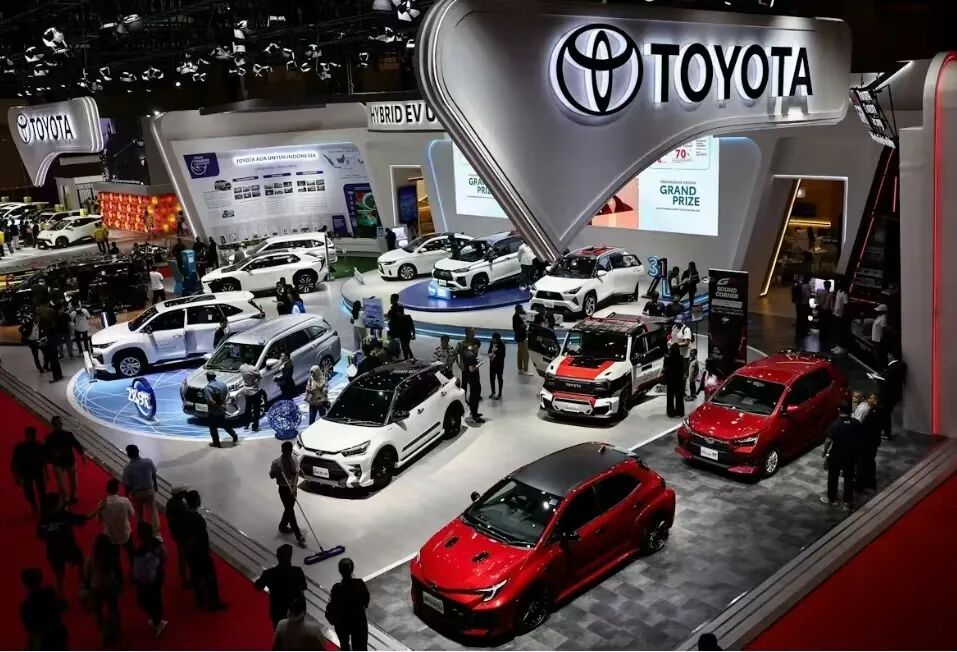
According to foreign media reports, at the recently concluded 47th Bangkok International Motor Show, the overall reservation volume of the Chinese contingent surpassed that of Japanese brands for the first time. According to the organizers' statistics, BYD ranked first in the show's reservation volume with 17,000 reservations (excluding Denza), surpassing Toyota's 15,700 reservations. Meanwhile, Chery's OMODA & JAECOO ranked third with 15,000 reservations. Among the top ten car brands in terms of reservation volume, Chinese automobiles occupied seven spots, with MG, Changan Automobile, Geely Automobile, Great Wall Motor, and Guangzhou Automobile Group all making the list. Honda, as the second Japanese car brand to make it into the Top 10 list, ranked tenth in terms of overall order volume at the show.
01 Chinese brands are going crazy in Thailand
The Chinese automotive industry has made rapid progress, while Japanese brands are gradually showing signs of fatigue. The Bangkok International Motor Show witnessed the rise of Chinese cars in the local market and became a vivid reflection of the changes in the automotive market landscape across Southeast Asia. The Southeast Asian automotive market has reached an inflection point. The era of "Japanese dominance" that lasted for more than half a century is gradually coming to an end. Japanese automotive giants, which once occupied nearly 90% of the Thai market and built an unshakable barrier, are now facing unprecedented market pressure and loss of share in the face of the collective onslaught and rapid progress of Chinese brands. According to data from the Federation of Thai Industries (FIT) Automotive Industry Association, among the top ten automakers in Thailand's automotive market in 2025, Toyota still ranked first with sales volume of 230,000 units, followed closely by Honda and Isuzu with 73,000 units. However, Chinese brands have occupied five seats, showing strong market growth momentum.
Among them, BYD ranked fourth with sales of nearly 40,000 units; MG broke through 27,000 annual sales, ranking fifth; Great Wall Motor, Changan Automobile, and Guangzhou Automobile ranked eighth to tenth with sales of 18,000, 14,000, and 13,000 units respectively. As early as 2019, Japanese brands held an overall share of 87% in the Thai automotive market, with a share of 89.6% in the passenger car segment and 85.3% in the commercial vehicle segment. This was the peak period for Japanese cars in the Thai market, when only a very small number of Chinese car brands, such as MG, were selling locally, accounting for only 2.8% of the market share. In just six years, the market landscape began to reverse, the monopoly advantage of Japanese cars continued to erode, and Chinese brands achieved leapfrog growth. In 2025, Chinese car sales in Thailand exceeded 100,000 units for the first time, reaching 134,000 units, a year-on-year increase of 81%. The market share increased by nearly 10 percentage points compared to 2024, reaching 22%, second only to the 68% share of Japanese cars. It is worth mentioning that this was also the first time that the market share of Japanese cars in Thailand fell below 70%.

This trend of mutual ebb and flow is particularly evident in the new energy sector. In 2025, Thailand's sales of pure electric vehicles reached approximately 120,000 units, marking an increase of about 80% year-on-year, with Chinese-branded electric vehicles accounting for over 80% of the market share. Looking ahead, this market landscape is expected to further solidify, and the growth momentum will become even more pronounced. According to data released by the Federation of Thai Industries (FIT) Automotive Industry Association, Thailand's total car sales last year reached 621,000 units, achieving a growth rate of up to 8.5% compared to 2024. The core driving force supporting this market growth stems from the rapid expansion of the new energy vehicle segment. Statistics show that Thailand's cumulative sales of new energy vehicles in 2025 amounted to 276,700 units, climbing to 45% of the overall sales. It is particularly noteworthy that pure electric vehicles are gradually establishing their dominant position in the market, with their sales share continuously expanding, becoming a significant driver for the overall increase in new car sales in the future.
The "fortress" of Japanese cars has been shaken by China
In the Southeast Asian market, Japanese automobiles have been deeply rooted for seven decades. After the 1950s, Japanese automakers gradually entered the Southeast Asian market. Later, due to the impact of the "Plaza Accord" on the yen, Japanese automakers accelerated their localization production on a large scale in the 1980s, establishing a highly mature industrial chain in various Southeast Asian countries. Because of this, Japanese automobiles "set up camp" in Southeast Asia about 30 years earlier than European, American, and Chinese automakers. All along, benefiting from the low investment and high return characteristics of the Southeast Asian market, Japanese automobiles have regarded this market as a veritable profit engine and cash cow, and also as one of the important "strongholds" for the stable global industrial chain of Japanese automobile manufacturing.
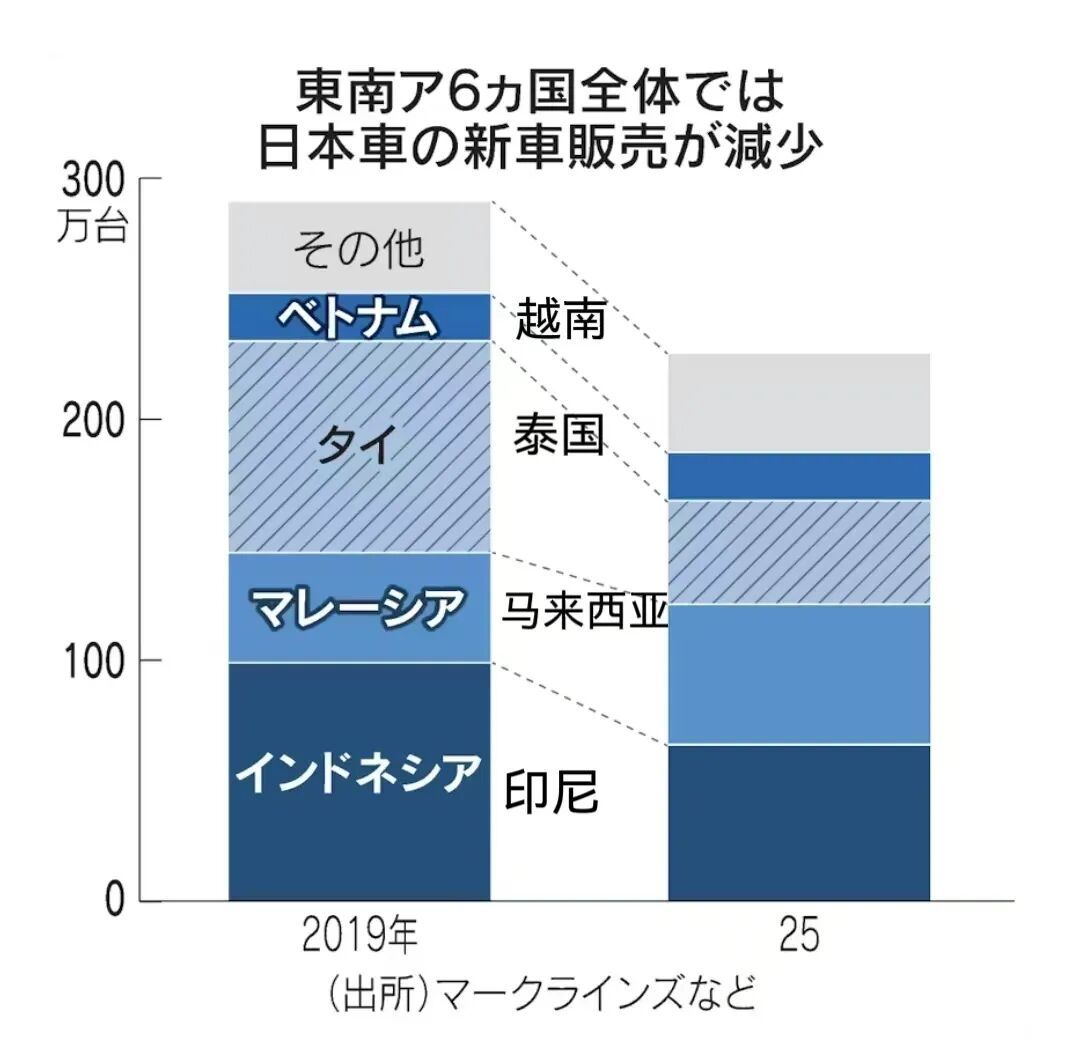
Nowadays, this "fortress" is being shaken by Chinese automobiles. Nihon Keizai Shimbun has compiled statistics on the proportion of Chinese and Japanese automobile companies in new car sales in six Southeast Asian countries in 2025, and the sales of Japanese cars have all been lower than the previous year's level. Over the past year, Japanese cars have sold a total of 2.27 million units in the six Southeast Asian countries, a decrease of 22% compared to the peak year of 2019. Among them, Indonesia's market share has declined sharply by more than 8 percentage points year-on-year, reaching only 81%; Thailand's market has declined by 9 percentage points, falling to 68%; Vietnam's market has declined by 6 percentage points, closing at 33%; Malaysia and the Philippines have also experienced a decline of 3-4 percentage points respectively, and Singapore has also declined by 6 percentage points.
Indonesia, which had long been the largest automobile market in Southeast Asia (slightly surpassed by Malaysia in 2025), serves as the industrial and profit core of the Southeast Asian region. Over the past few years, it has become a "new battleground" for Chinese automobiles seeking to expand overseas. According to statistics from Nihon Keizai Shimbun, in 2025 alone, the market share of Chinese automobiles in Indonesia more than doubled year-on-year, reaching 14%. It is worth mentioning that nearly half of the sales were contributed by BYD. The watershed moment came around 2023. That year, the policy window for Southeast Asia was fully opened, becoming the most critical external condition for Chinese automobiles to "seize" the Southeast Asian market. Since 2022, the Thai government has launched the new energy vehicle incentive policy EV3.0, stimulating the market through a series of combined measures, and the policy has yielded immediate results. At the end of 2023, Thailand introduced EV3.5, which mainly includes providing purchase subsidies, as well as reductions in consumption tax, road tax, and import tax.
In 2023, Malaysia announced an investment of 95 billion ringgit for the development of advanced manufacturing, with a focus on new energy vehicle (NEV) research and development. In addition, the government has introduced a series of tax relief measures, such as the reduction of NEV road tax. From sporadic overseas expansion to taking root in the system, in just three years, Chinese automobile companies have made a crucial leap from product export to industrial establishment in Southeast Asia - the coordinated implementation of complete vehicles, batteries, core components, and charging networks, building their own new energy industry ecosystem barriers with efficient cost control and highly competitive pricing strategies. The market landscape, once dominated by Japanese companies for a long time, is quietly being rewritten. A more open, diverse, and vibrant new era of Southeast Asian automobiles is gradually unfolding with the deep participation of China's intelligent manufacturing.
AMS2024 Exhibition Guide | Comprehensive Exhibition Guide, Don't Miss the Exciting Events Online and Offline
Notice on Holding the Rui'an Promotion Conference for the 2025 China (Rui'an) International Automobile and Motorcycle Parts Exhibition
On September 5th, we invite you to join us at the Wenzhou Auto Parts Exhibition on a journey to trace the origin of the Auto Parts City, as per the invitation from the purchaser!
Hot Booking | AAPEX 2024- Professional Exhibition Channel for Entering the North American Auto Parts Market
The wind is just right, Qianchuan Hui! Looking forward to working with you at the 2024 Wenzhou Auto Parts Exhibition and composing a new chapter!
Live up to Shaohua | Wenzhou Auto Parts Exhibition, these wonderful moments are worth remembering!
Free support line!
Email Support!
Working Days/Hours!



Copyright © 2018, PKT Auto Parts All Rights Reserved
浙ICP备18033565号-1
 浙公网安备33038102332475号